Blog
The OCaml Planet RSS
Articles and videos contributed by both experts, companies and passionate developers from the OCaml community. From in-depth technical articles, project highlights, community news, or insights into Open Source projects, the OCaml Planet RSS feed aggregator has something for everyone.
Source
Keyword
Year
Author
Want your Blog Posts or Videos to Show Here?
To contribute a blog post, or add your RSS feed, check out the Contributing Guide on GitHub.
I’ve taken a few days off, and while I’ve been travelling, I’ve been working on a personal project with Claude. I’ve used Claude Code for the first time, which is a much more powerful experience than using claude.ai as Claude can apply changes to the code and use your build tools directly to quickly iterate on a problem. In another first, I used js_of_ocaml, which has been awesome.

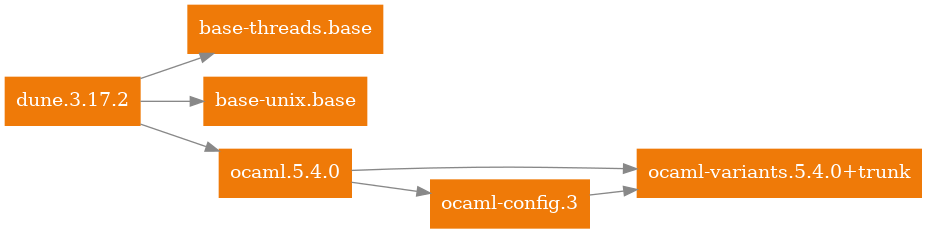
I have previously written about using a topological sort of a directed acyclic graph (DAG) of package dependencies to create an ordered list of installation operations. I now want to create a transitive reduction, giving a graph with the same vertices and the fewest number of edges possible.
OCaml is famous for allow you to do a lot of things like modules. Like really a lot! Advanced features like functors, aside, it’s really common to either alias module names to something shorter or localize open Module_name to a smaller scope:

In my previous article I mentioned that OCaml’s Stdlib leaves a lot to be desire when it comes to regular expressions. One thing I didn’t discuss back then was that the problem is somewhat mitigated by the excellent module Scanf, which makes it easy to parse structured data.
One of the things that bothered me initially in OCaml was the poor support for working in regular expressions in the standard library. Technically speaking, there’s no support for them at all!
One thing I’ve noticed on my journey to learn OCaml was that reading (text) files wasn’t as straightforward as with many other programming languages. To give you some point of reference - here’s how easy it is to do this in Ruby:
Bucket Sort Bucket sort assumes input generated by a random process that distributes elements uniformly over the interval [0, 1) . ...

The type of "association tables" (binary search trees). type (α, β) t = | Empty | Node of (α , β) t * α * β * (α, β) t * int There are tw...
The Binary Analysis Platform Blog
In part 1 I showed how a simple make rule could be converted to a special “goal” function and I hinted that we were not limited to just the “file is older than” semantics im…