Blog
The OCaml Planet RSS
Articles and videos contributed by both experts, companies and passionate developers from the OCaml community. From in-depth technical articles, project highlights, community news, or insights into Open Source projects, the OCaml Planet RSS feed aggregator has something for everyone.
Source
Keyword
Year
Author
Want your Blog Posts or Videos to Show Here?
To contribute a blog post, or add your RSS feed, check out the Contributing Guide on GitHub.

A few days after retiring opam 2.0 from the build pipeline, ocaml-ci Jon noticed that some jobs were failing. I immediately concluded that the removal was to blame, but it wasn’t.

The base image builder has a growing number of failed builds; it’s time to address these.

opam 2.5.0 was released on 27th November, and this update needs to be propagated through the CI infrastructure. This post mirrors the steps taken for the release of opam 2.4.1.
In Numberphile’s latest video, Tony Padilla does a ‘magic trick’ with Fibonacci numbers and talks about Zeckendorf decompositions, and I had my laptop out even before the video ended.

We are increasingly hitting the Docker Hub rate limits when pushing the Docker base images. This issue was previously identified in issue #267. However, this is now becoming critical as many more jobs are failing.

FreeBSD Jails provide isolated system containers that are perfect for CI testing. Miod ported OBuilder to FreeBSD back in 2023. I have been looking at some different approaches using unionfs.

opam 2.4.0 was released on 18th July followed by opam 2.4.1 a few days later. This update needs to be propagated through the CI infrastructure. The first step is to update the base images for each OS.
Today I’m going to cover a very basic topic - conversions between OCaml’s primary numeric types int and float. I guess most of you are wondering if such a basic topic deserves a special treatment, but if you read on I promise that it will be worth it.

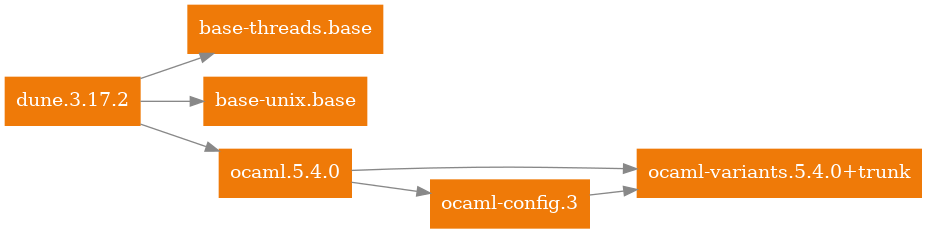
I have previously written about using a topological sort of a directed acyclic graph (DAG) of package dependencies to create an ordered list of installation operations. I now want to create a transitive reduction, giving a graph with the same vertices and the fewest number of edges possible.