Exercise Categories
Lists
Tail of a List Last Two Elements of a List N'th Element of a List Length of a List Reverse a List Palindrome Run-Length Encoding Modified Run-Length Encoding Duplicate the Elements of a List Split a List Into Two Parts; The Length of the First Part Is Given Remove the K'th Element From a List Insert an Element at a Given Position Into a List Create a List Containing All Integers Within a Given Range Lotto: Draw N Different Random Numbers From the Set 1..M Generate a Random Permutation of the Elements of a ListArithmetic
Determine Whether Two Positive Integer Numbers Are Coprime Compare the Two Methods of Calculating Euler's Totient Function A List of Prime NumbersLogic and Codes
Binary Trees
Count the Leaves of a Binary Tree Collect the Leaves of a Binary Tree in a List Collect the Internal Nodes of a Binary Tree in a List Collect the Nodes at a Given Level in a ListMultiway Trees
Count the Nodes of a Multiway Tree Determine the Internal Path Length of a Tree Construct the Bottom-Up Order Sequence of the Tree NodesMiscellaneous
Exercises
This section is inspired by Ninety-Nine Lisp Problems which in turn was based on “Prolog problem list” by Werner Hett. For each of these questions, some simple tests are shown—they may also serve to make the question clearer if needed. To work on these problems, we recommend you first install OCaml or use it inside your browser. The source of the following problems is available on GitHub.
Every exercise has a difficulty level, ranging from beginner to advanced.
Tail of a List
Write a function last : 'a list -> 'a option that returns the last element of a list
# last ["a" ; "b" ; "c" ; "d"];;
- : string option = Some "d"
# last [];;
- : 'a option = None
# let rec last = function
  | [] -> None
  | [ x ] -> Some x
  | _ :: t -> last t;;
val last : 'a list -> 'a option = <fun>
Last Two Elements of a List
Find the last two (last and penultimate) elements of a list.
# last_two ["a"; "b"; "c"; "d"];;
- : (string * string) option = Some ("c", "d")
# last_two ["a"];;
- : (string * string) option = None
# let rec last_two = function
    | [] | [_] -> None
    | [x; y] -> Some (x,y)
    | _ :: t -> last_two t;;
val last_two : 'a list -> ('a * 'a) option = <fun>
N'th Element of a List
Find the N'th element of a list.
# at 2 ["a"; "b"; "c"; "d"; "e"];;
- : string option = Some "c"
# at 2 ["a"];;
- : string option = None
Remark: OCaml has List.nth which numbers elements from 0 and
raises an exception if the index is out of bounds.
# List.nth ["a"; "b"; "c"; "d"; "e"] 2;;
- : string = "c"
# List.nth ["a"] 2;;
Exception: Failure "nth".
# let rec at k = function
    | [] -> None
    | h :: t -> if k = 0 then Some h else at (k - 1) t;;
val at : int -> 'a list -> 'a option = <fun>
Length of a List
Find the number of elements of a list.
OCaml standard library has List.length but we ask that you reimplement
it. Bonus for a tail recursive
solution.
# length ["a"; "b"; "c"];;
- : int = 3
# length [];;
- : int = 0
This function is tail-recursive: it uses a constant amount of stack memory regardless of list size.
# let length list =
    let rec aux n = function
      | [] -> n
      | _ :: t -> aux (n + 1) t
    in
    aux 0 list;;
val length : 'a list -> int = <fun>
Reverse a List
Reverse a list.
OCaml standard library has List.rev but we ask that you reimplement
it.
# rev ["a"; "b"; "c"];;
- : string list = ["c"; "b"; "a"]
# let rev list =
    let rec aux acc = function
      | [] -> acc
      | h :: t -> aux (h :: acc) t
    in
    aux [] list;;
val rev : 'a list -> 'a list = <fun>
Palindrome
Find out whether a list is a palindrome.
Hint: A palindrome is its own reverse.
# is_palindrome ["x"; "a"; "m"; "a"; "x"];;
- : bool = true
# not (is_palindrome ["a"; "b"]);;
- : bool = true
# let is_palindrome list =
    (* One can use either the rev function from the previous problem, or the built-in List.rev *)
    list = List.rev list;;
val is_palindrome : 'a list -> bool = <fun>
Run-Length Encoding
If you need to, refresh your memory about run-length encoding.
Here is an example:
# encode ["a"; "a"; "a"; "a"; "b"; "c"; "c"; "a"; "a"; "d"; "e"; "e"; "e"; "e"];;
- : (int * string) list =
[(4, "a"); (1, "b"); (2, "c"); (2, "a"); (1, "d"); (4, "e")]
# let encode list =
    let rec aux count acc = function
      | [] -> [] (* Can only be reached if original list is empty *)
      | [x] -> (count + 1, x) :: acc
      | a :: (b :: _ as t) -> if a = b then aux (count + 1) acc t
                              else aux 0 ((count + 1, a) :: acc) t in
    List.rev (aux 0 [] list);;
val encode : 'a list -> (int * 'a) list = <fun>
An alternative solution, which is shorter but requires more memory, is to use
the pack function declared in problem 9:
# let pack list =
    let rec aux current acc = function
      | [] -> []    (* Can only be reached if original list is empty *)
      | [x] -> (x :: current) :: acc
      | a :: (b :: _ as t) ->
         if a = b then aux (a :: current) acc t
         else aux [] ((a :: current) :: acc) t  in
    List.rev (aux [] [] list);;
val pack : 'a list -> 'a list list = <fun>
# let encode list =
    List.map (fun l -> (List.length l, List.hd l)) (pack list);;
val encode : 'a list -> (int * 'a) list = <fun>
Modified Run-Length Encoding
Modify the result of the previous problem in such a way that if an element has no duplicates it is simply copied into the result list. Only elements with duplicates are transferred as (N E) lists.
Since OCaml lists are homogeneous, one needs to define a type to hold both single elements and sub-lists.
type 'a rle =
  | One of 'a
  | Many of int * 'a
# encode ["a"; "a"; "a"; "a"; "b"; "c"; "c"; "a"; "a"; "d"; "e"; "e"; "e"; "e"];;
- : string rle list =
[Many (4, "a"); One "b"; Many (2, "c"); Many (2, "a"); One "d";
 Many (4, "e")]
# type 'a rle =
  | One of 'a
  | Many of int * 'a;;
type 'a rle = One of 'a | Many of int * 'a
# let encode l =
    let create_tuple cnt elem =
      if cnt = 1 then One elem
      else Many (cnt, elem) in
    let rec aux count acc = function
      | [] -> []
      | [x] -> (create_tuple (count + 1) x) :: acc
      | hd :: (snd :: _ as tl) ->
          if hd = snd then aux (count + 1) acc tl
          else aux 0 ((create_tuple (count + 1) hd) :: acc) tl in
      List.rev (aux 0 [] l);;
val encode : 'a list -> 'a rle list = <fun>
Duplicate the Elements of a List
Duplicate the elements of a list.
# duplicate ["a"; "b"; "c"; "c"; "d"];;
- : string list = ["a"; "a"; "b"; "b"; "c"; "c"; "c"; "c"; "d"; "d"]
# let rec duplicate = function
    | [] -> []
    | h :: t -> h :: h :: duplicate t;;
val duplicate : 'a list -> 'a list = <fun>
Remark: this function is not tail recursive. Can you modify it so it becomes so?
Split a List Into Two Parts; The Length of the First Part Is Given
Split a list into two parts; the length of the first part is given.
If the length of the first part is longer than the entire list, then the first part is the list and the second part is empty.
# split ["a"; "b"; "c"; "d"; "e"; "f"; "g"; "h"; "i"; "j"] 3;;
- : string list * string list =
(["a"; "b"; "c"], ["d"; "e"; "f"; "g"; "h"; "i"; "j"])
# split ["a"; "b"; "c"; "d"] 5;;
- : string list * string list = (["a"; "b"; "c"; "d"], [])
# let split list n =
    let rec aux i acc = function
      | [] -> List.rev acc, []
      | h :: t as l -> if i = 0 then List.rev acc, l
                       else aux (i - 1) (h :: acc) t
    in
      aux n [] list;;
val split : 'a list -> int -> 'a list * 'a list = <fun>
Remove the K'th Element From a List
Remove the K'th element from a list.
The first element of the list is numbered 0, the second 1,...
# remove_at 1 ["a"; "b"; "c"; "d"];;
- : string list = ["a"; "c"; "d"]
# let rec remove_at n = function
    | [] -> []
    | h :: t -> if n = 0 then t else h :: remove_at (n - 1) t;;
val remove_at : int -> 'a list -> 'a list = <fun>
Insert an Element at a Given Position Into a List
Start counting list elements with 0. If the position is larger or equal to the length of the list, insert the element at the end. (The behavior is unspecified if the position is negative.)
# insert_at "alfa" 1 ["a"; "b"; "c"; "d"];;
- : string list = ["a"; "alfa"; "b"; "c"; "d"]
# let rec insert_at x n = function
    | [] -> [x]
    | h :: t as l -> if n = 0 then x :: l else h :: insert_at x (n - 1) t;;
val insert_at : 'a -> int -> 'a list -> 'a list = <fun>
Create a List Containing All Integers Within a Given Range
If first argument is greater than second, produce a list in decreasing order.
# range 4 9;;
- : int list = [4; 5; 6; 7; 8; 9]
# let range a b =
    let rec aux a b =
      if a > b then [] else a :: aux (a + 1) b
    in
      if a > b then List.rev (aux b a) else aux a b;;
val range : int -> int -> int list = <fun>
A tail recursive implementation:
# let range a b =
    let rec aux acc high low =
      if high >= low then
        aux (high :: acc) (high - 1) low
      else acc
    in
      if a < b then aux [] b a else List.rev (aux [] a b);;
val range : int -> int -> int list = <fun>
Lotto: Draw N Different Random Numbers From the Set 1..M
Draw N different random numbers from the set 1..M.
The selected numbers shall be returned in a list.
# lotto_select 6 49;;
- : int list = [20; 28; 45; 16; 24; 38]
# (* [range] and [rand_select] defined in problems above *)
  let lotto_select n m = rand_select (range 1 m) n;;
val lotto_select : int -> int -> int list = <fun>
Generate a Random Permutation of the Elements of a List
Generate a random permutation of the elements of a list.
# permutation ["a"; "b"; "c"; "d"; "e"; "f"];;
- : string list = ["c"; "d"; "f"; "e"; "b"; "a"]
# let permutation list =
    let rec extract acc n = function
      | [] -> raise Not_found
      | h :: t -> if n = 0 then (h, acc @ t) else extract (h :: acc) (n - 1) t
    in
    let extract_rand list len =
      extract [] (Random.int len) list
    in
    let rec aux acc list len =
      if len = 0 then acc else
        let picked, rest = extract_rand list len in
        aux (picked :: acc) rest (len - 1)
    in
    aux [] list (List.length list);;
val permutation : 'a list -> 'a list = <fun>
Determine Whether Two Positive Integer Numbers Are Coprime
Determine whether two positive integer numbers are coprime.
Two numbers are coprime if their greatest common divisor equals 1.
# coprime 13 27;;
- : bool = true
# not (coprime 20536 7826);;
- : bool = true
# (* [gcd] is defined in the previous question *)
  let coprime a b = gcd a b = 1;;
val coprime : int -> int -> bool = <fun>
Compare the Two Methods of Calculating Euler's Totient Function
Use the solutions of problems "Calculate Euler's totient function φ(m)" and "Calculate Euler's totient function φ(m) (improved)" to compare the algorithms. Take the number of logical inferences as a measure for efficiency. Try to calculate φ(10090) as an example.
timeit phi 10090
# (* Naive [timeit] function.  It requires the [Unix] module to be loaded. *)
  let timeit f a =
    let t0 = Unix.gettimeofday() in
      ignore (f a);
    let t1 = Unix.gettimeofday() in
      t1 -. t0;;
val timeit : ('a -> 'b) -> 'a -> float = <fun>
A List of Prime Numbers
Given a range of integers by its lower and upper limit, construct a list of all prime numbers in that range.
# List.length (all_primes 2 7920);;
- : int = 1000
# let is_prime n =
    let n = max n (-n) in
    let rec is_not_divisor d =
      d * d > n || (n mod d <> 0 && is_not_divisor (d + 1))
    in
      is_not_divisor 2

  let rec all_primes a b =
    if a > b then [] else
      let rest = all_primes (a + 1) b in
      if is_prime a then a :: rest else rest;;
val is_prime : int -> bool = <fun>
val all_primes : int -> int -> int list = <fun>
Count the Leaves of a Binary Tree
A leaf is a node with no successors. Write a function count_leaves to
count them.
# count_leaves Empty;;
- : int = 0
# let rec count_leaves = function
    | Empty -> 0
    | Node (_, Empty, Empty) -> 1
    | Node (_, l, r) -> count_leaves l + count_leaves r;;
val count_leaves : 'a binary_tree -> int = <fun>
Collect the Leaves of a Binary Tree in a List
A leaf is a node with no successors. Write a function leaves to
collect them in a list.
# leaves Empty;;
- : 'a list = []
# (* Having an accumulator acc prevents using inefficient List.append.
   * Every Leaf will be pushed directly into accumulator.
   * Not tail-recursive, but that is no problem since we have a binary tree and
   * and stack depth is logarithmic. *)
  let leaves t =
    let rec leaves_aux t acc = match t with
      | Empty -> acc
      | Node (x, Empty, Empty) -> x :: acc
      | Node (x, l, r) -> leaves_aux l (leaves_aux r acc)
    in
    leaves_aux t [];;
val leaves : 'a binary_tree -> 'a list = <fun>
Collect the Internal Nodes of a Binary Tree in a List
An internal node of a binary tree has either one or two non-empty
successors. Write a function internals to collect them in a list.
# internals (Node ('a', Empty, Empty));;
- : char list = []
# (* Having an accumulator acc prevents using inefficient List.append.
   * Every internal node will be pushed directly into accumulator.
   * Not tail-recursive, but that is no problem since we have a binary tree and
   * and stack depth is logarithmic. *)
  let internals t =
    let rec internals_aux t acc = match t with
      | Empty -> acc
      | Node (x, Empty, Empty) -> acc
      | Node (x, l, r) -> internals_aux l (x :: internals_aux r acc)
    in
    internals_aux t [];;
val internals : 'a binary_tree -> 'a list = <fun>
Collect the Nodes at a Given Level in a List
A node of a binary tree is at level N if the path from the root to the
node has length N-1. The root node is at level 1. Write a function
at_level t l to collect all nodes of the tree t at level l in a
list.
# let example_tree =
  Node ('a', Node ('b', Node ('d', Empty, Empty), Node ('e', Empty, Empty)),
       Node ('c', Empty, Node ('f', Node ('g', Empty, Empty), Empty)));;
val example_tree : char binary_tree =
  Node ('a', Node ('b', Node ('d', Empty, Empty), Node ('e', Empty, Empty)),
   Node ('c', Empty, Node ('f', Node ('g', Empty, Empty), Empty)))
# at_level example_tree 2;;
- : char list = ['b'; 'c']
Using at_level it is easy to construct a function levelorder which
creates the level-order sequence of the nodes. However, there are more
efficient ways to do that.
# (* Having an accumulator acc prevents using inefficient List.append.
   * Every node at level N will be pushed directly into accumulator.
   * Not tail-recursive, but that is no problem since we have a binary tree and
   * and stack depth is logarithmic. *)
  let at_level t level =
    let rec at_level_aux t acc counter = match t with
      | Empty -> acc
      | Node (x, l, r) ->
        if counter=level then
          x :: acc
        else
          at_level_aux l (at_level_aux r acc (counter + 1)) (counter + 1)
    in
      at_level_aux t [] 1;;
val at_level : 'a binary_tree -> int -> 'a list = <fun>
Count the Nodes of a Multiway Tree
# count_nodes (T ('a', [T ('f', []) ]));;
- : int = 2
# let rec count_nodes (T (_, sub)) =
    List.fold_left (fun n t -> n + count_nodes t) 1 sub;;
val count_nodes : 'a mult_tree -> int = <fun>
Determine the Internal Path Length of a Tree
We define the internal path length of a multiway tree as the total sum
of the path lengths from the root to all nodes of the tree. By this
definition, the tree t in the figure of the previous problem has an
internal path length of 9. Write a function ipl tree that returns the
internal path length of tree.
# ipl t;;
- : int = 9
# let rec ipl_sub len (T(_, sub)) =
    (* [len] is the distance of the current node to the root.  Add the
       distance of all sub-nodes. *)
    List.fold_left (fun sum t -> sum + ipl_sub (len + 1) t) len sub
  let ipl t = ipl_sub 0 t;;
val ipl_sub : int -> 'a mult_tree -> int = <fun>
val ipl : 'a mult_tree -> int = <fun>
Construct the Bottom-Up Order Sequence of the Tree Nodes
Write a function bottom_up t which constructs the bottom-up sequence
of the nodes of the multiway tree t.
# bottom_up (T ('a', [T ('b', [])]));;
- : char list = ['b'; 'a']
# bottom_up t;;
- : char list = ['g'; 'f'; 'c'; 'd'; 'e'; 'b'; 'a']
# let rec prepend_bottom_up (T (c, sub)) l =
    List.fold_right (fun t l -> prepend_bottom_up t l) sub (c :: l)
  let bottom_up t = prepend_bottom_up t [];;
val prepend_bottom_up : 'a mult_tree -> 'a list -> 'a list = <fun>
val bottom_up : 'a mult_tree -> 'a list = <fun>
Conversions
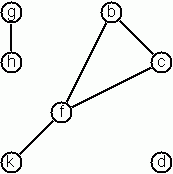
A graph is defined as a set of nodes and a set of edges, where each edge is a pair of different nodes.
There are several ways to represent graphs in OCaml.
- One method is to list all edges, an edge being a pair of nodes. In this form, the graph depicted above is represented as the following expression:
# [('h', 'g'); ('k', 'f'); ('f', 'b'); ('f', 'c'); ('c', 'b')];;
- : (char * char) list =
[('h', 'g'); ('k', 'f'); ('f', 'b'); ('f', 'c'); ('c', 'b')]
We call this edge-clause form. Obviously, isolated nodes cannot be represented.
- Another method is to represent the whole graph as one data object. According to the definition of the graph as a pair of two sets (nodes and edges), we may use the following OCaml type:
# type 'a graph_term = {nodes : 'a list;  edges : ('a * 'a) list};;
type 'a graph_term = { nodes : 'a list; edges : ('a * 'a) list; }
Then, the above example graph is represented by:
# let example_graph =
  {nodes = ['b'; 'c'; 'd'; 'f'; 'g'; 'h'; 'k'];
   edges = [('h', 'g'); ('k', 'f'); ('f', 'b'); ('f', 'c'); ('c', 'b')]};;
val example_graph : char graph_term =
  {nodes = ['b'; 'c'; 'd'; 'f'; 'g'; 'h'; 'k'];
   edges = [('h', 'g'); ('k', 'f'); ('f', 'b'); ('f', 'c'); ('c', 'b')]}
We call this graph-term form. Note, that the lists are kept
sorted, they are really sets, without duplicated elements. Each edge
appears only once in the edge list; i.e. an edge from a node x to
another node y is represented as (x, y), the couple (y, x) is not
present. The graph-term form is our default representation. You
may want to define a similar type using sets instead of lists.
- A third representation method is to associate with each node the set of nodes that are adjacent to that node. We call this the adjacency-list form. In our example:
# let adjacency_example = ['b', ['c'; 'f'];
                         'c', ['b'; 'f'];
                         'd', [];
                         'f', ['b'; 'c'; 'k'];
                         'g', ['h'];
                         'h', ['g'];
                         'k', ['f']
                         ];;
val adjacency_example : (char * char list) list =
  [('b', ['c'; 'f']); ('c', ['b'; 'f']); ('d', []); ('f', ['b'; 'c'; 'k']);
   ('g', ['h']); ('h', ['g']); ('k', ['f'])]
- The representations we introduced so far are well suited for automated processing, but their syntax is not very user-friendly. Typing the terms by hand is cumbersome and error-prone. We can define a more compact and "human-friendly" notation as follows: A graph (with char labelled nodes) is represented by a string of atoms and terms of the type X-Y. The atoms stand for isolated nodes, the X-Y terms describe edges. If an X appears as an endpoint of an edge, it is automatically defined as a node. Our example could be written as:
# "b-c f-c g-h d f-b k-f h-g";;
- : string = "b-c f-c g-h d f-b k-f h-g"
We call this the human-friendly form. As the example shows, the
list does not have to be sorted and may even contain the same edge
multiple times. Notice the isolated node d.
Write functions to convert between the different graph representations. With these functions, all representations are equivalent; i.e. for the following problems you can always pick freely the most convenient form. This problem is not particularly difficult, but it's a lot of work to deal with all the special cases.
(* example pending *)
Cycle From a Given Node
Write a function cycle g a that returns a closed path (cycle) p
starting at a given node a in the graph g. The predicate should
return the list of all cycles via backtracking.
# let example_graph =
  {nodes = ['b'; 'c'; 'd'; 'f'; 'g'; 'h'; 'k'];
   edges = [('h', 'g'); ('k', 'f'); ('f', 'b'); ('f', 'c'); ('c', 'b')]};;
val example_graph : char graph_term =
  {nodes = ['b'; 'c'; 'd'; 'f'; 'g'; 'h'; 'k'];
   edges = [('h', 'g'); ('k', 'f'); ('f', 'b'); ('f', 'c'); ('c', 'b')]}
# cycles example_graph 'f';;
- : char list list =
[['f'; 'b'; 'c'; 'f']; ['f'; 'c'; 'f']; ['f'; 'c'; 'b'; 'f'];
 ['f'; 'b'; 'f']; ['f'; 'k'; 'f']]
# let cycles g a =
    let n = neighbors g a (fun _ -> true) in
    let p = List.concat_map (fun c -> list_path g a [c]) n in
    List.map (fun p -> p @ [a]) p;;
val cycles : 'a graph_term -> 'a -> 'a list list = <fun>
Never-Ending Sequences
Lists are finite, meaning they always contain a finite number of elements. Sequences may be finite or infinite.
The goal of this exercise is to define a type 'a stream which only contains
infinite sequences. Using this type, define the following functions:
val hd : 'a stream -> 'a
(** Returns the first element of a stream *)
val tl : 'a stream -> 'a stream
(** Removes the first element of a stream *)
val take : int -> 'a stream -> 'a list
(** [take n seq] returns the n first values of [seq] *)
val unfold : ('a -> 'b * 'a) -> 'a -> 'b stream
(** Similar to Seq.unfold *)
val bang : 'a -> 'a stream
(** [bang x] produces an infinitely repeating sequence of [x] values. *)
val ints : int -> int stream
(* Similar to Seq.ints *)
val map : ('a -> 'b) -> 'a stream -> 'b stream
(** Similar to List.map and Seq.map *)
val filter: ('a -> bool) -> 'a stream -> 'a stream
(** Similar to List.filter and Seq.filter *)
val iter : ('a -> unit) -> 'a stream -> 'b
(** Similar to List.iter and Seq.iter *)
val to_seq : 'a stream -> 'a Seq.t
(** Translates an ['a stream] into an ['a Seq.t] *)
val of_seq : 'a Seq.t -> 'a stream
(** Translates an ['a Seq.t] into an ['a stream]
    @raise Failure if the input sequence is finite. *)
Tip: Use let ... = patterns.
type 'a cons = Cons of 'a * 'a stream
and 'a stream = unit -> 'a cons

let hd (seq : 'a stream) = let (Cons (x, _)) = seq () in x
let tl (seq : 'a stream) = let (Cons (_, seq)) = seq () in seq
let rec take n seq = if n = 0 then [] else let (Cons (x, seq)) = seq () in x :: take (n - 1) seq
let rec unfold f x () = let (y, x) = f x in Cons (y, unfold f x)
let bang x = unfold (fun x -> (x, x)) x
let ints x = unfold (fun x -> (x, x + 1)) x
let rec map f seq () = let (Cons (x, seq)) = seq () in Cons (f x, map f seq)
let rec filter p seq () = let (Cons (x, seq)) = seq () in let seq = filter p seq in if p x then Cons (x, seq) else seq ()
let rec iter f seq = let (Cons (x, seq)) = seq () in f x; iter f seq
let to_seq seq = Seq.unfold (fun seq -> Some (hd seq, tl seq)) seq
let rec of_seq seq () = match seq () with
| Seq.Nil -> failwith "Not a infinite sequence"
| Seq.Cons (x, seq) -> Cons (x, of_seq seq)