Blog
The OCaml Planet RSS
Articles and videos contributed by both experts, companies and passionate developers from the OCaml community. From in-depth technical articles, project highlights, community news, or insights into Open Source projects, the OCaml Planet RSS feed aggregator has something for everyone.
Want your Blog Posts or Videos to Show Here?
To contribute a blog post, or add your RSS feed, check out the Contributing Guide on GitHub.
Presented by: Lindsey Kuper Parallel and distributed systems are notoriously difficult to build correctly or efficiently. In parallel systems, the manipulation of shared state can cause unintended behavior in the presence of unpredictable task scheduling, while in distributed systems, the manipulation of replicated state can cause unintended behavior in the presence of an unreliable network. Meanwhile, decades of research have not yet produced a general solution to the problem of automatic program parallelization. In this talk, I discuss how my research addresses these challenges from both theoretical and applied points of view. My work on lattice-based data structures, or LVars, proposes new foundations for expressive deterministic-by-construction parallel and distributed programming models. My work on non-invasive domain-specific languages for parallelism gives programmers language-based tools for safe, deterministic parallelization. The guiding principle and goal of both of these lines of work is to find the right high-level abstractions to express computation in a way that not only does not compromise efficiency, but actually enables it. I conclude by discussing the role that this principle of finding the right efficiency-enabling abstractions can play in my ongoing investigation into SMT-based verification of neural networks. Lindsey Kuper Lindsey Kuper (https://users.soe.ucsc.edu/~lkuper/) is an Assistant Professor of Computer Science and Engineering at the University of California, Santa Cruz, where she works on language-based approaches to building software systems that are correct and efficient. She holds a Ph.D. in computer science from Indiana University and a BA in computer science and music from Grinnell College. Prior to joining UC Santa Cruz, she was a Research Scientist in the Parallel Computing Lab at Intel Labs. During her Ph.D. years, she contributed to the Rust programming language at Mozilla Research, served several residencies at the Recurse Center, and co-founded !!Con (http://bangbangcon.com), the annual conference of ten-minute talks about the joy, excitement, and surprise of computing.

Presented by Anil Madhavapeddy (@avsm) We keep being told ReasonML can compile to native and do interop with OCaml, and that there's a wealth of existing code and tools we can draw into our applications - but how do we get there? This video will ...

Most of the time, our relationship to programming languages is somewhat remote; we depend on the arcane details of the languages we use, but we don’t usually have much of a say in how those languages evolve. At Jane Street, we started out in that mode, as a mere user of the language. But over the last 15 years, we’ve moved to a more active stance, where today, we have a team of compiler devs who actively contribute to OCaml, and where we’re more deeply involved in figuring out the future direction of the language. In this talk, we discuss that history, touching on how upstream changes impacted us along the way, how we came to start making changes ourselves, and what ongoing projects we’re excited about. Presented by Yaron Minsky Yaron Minsky joined Jane Street back in 2002, and claims the dubious honor of having convinced the firm to start using OCaml. He also spends way too much time teaching his kids how to program.
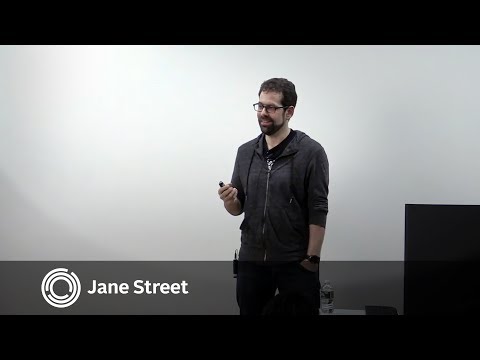
Most of the time, our relationship to programming languages is somewhat remote; we depend on the arcane details of the languages we use, but we don’t usually have much of a say in how those languages evolve. At Jane Street, we started out in that mode, as a mere user of the language. But over the last 15 years, we’ve moved to a more active stance, where today, we have a team of compiler devs who actively contribute to OCaml, and where we’re more deeply involved in figuring out the future direction of the language. In this talk, we discuss that history, touching on how upstream changes impacted us along the way, how we came to start making changes ourselves, and what ongoing projects we’re excited about. Presented by Yaron Minsky Yaron Minsky joined Jane Street back in 2002, and claims the dubious honor of having convinced the firm to start using OCaml. He also spends way too much time teaching his kids how to program.
Speaker: Hongbo Zhang
Speaker: Charles Chamberlain
Speaker: Frédéric Bour
Speaker: David Allsopp
Did you know that Jane Street uses OCaml for, like, everything? Did you also know that Jane Street builds FPGA designs? A problem? Come and find out how we design and test our FPGAs. We'll have some fun (or terrible disasters) with some demos on the Arty A7 hobbyist FPGA board, with the design expressed using HardCaml, an OCaml library for creating hardware designs, and driven by an embedded software stack written in OCaml and using ports of your favorite Jane Street libraries. I'll round up with some thoughts on the pros and cons of writing hardware in OCaml, and talk about some ideas we would like to explore to make the process more productive in the future. Presented by: Andy Ray Andy has been designing IP cores for nearly 20 years mainly in the areas of networking and video coding. Frustration with standard RTL development processes led him to develop the HardCaml suite of hardware design tools in OCaml. Then one day while down at the pub he got an email from Jane Street wondering about some sort of collaboration, and the rest is history.
Did you know that Jane Street uses OCaml for, like, everything? Did you also know that Jane Street builds FPGA designs? A problem? Come and find out how we design and test our FPGAs. We'll have some fun (or terrible disasters) with some demos on the Arty A7 hobbyist FPGA board, with the design expressed using HardCaml, an OCaml library for creating hardware designs, and driven by an embedded software stack written in OCaml and using ports of your favorite Jane Street libraries. I'll round up with some thoughts on the pros and cons of writing hardware in OCaml, and talk about some ideas we would like to explore to make the process more productive in the future. Presented by: Andy Ray Andy has been designing IP cores for nearly 20 years mainly in the areas of networking and video coding. Frustration with standard RTL development processes led him to develop the HardCaml suite of hardware design tools in OCaml. Then one day while down at the pub he got an email from Jane Street wondering about some sort of collaboration, and the rest is history.