Blog
The OCaml Planet RSS
Articles and videos contributed by both experts, companies and passionate developers from the OCaml community. From in-depth technical articles, project highlights, community news, or insights into Open Source projects, the OCaml Planet RSS feed aggregator has something for everyone.
Want your Blog Posts or Videos to Show Here?
To contribute a blog post, or add your RSS feed, check out the Contributing Guide on GitHub.
It’s a software engineer’s dream: A compiler that can take idiomatic high-level code and output maximally efficient instructions. Ron’s guest this week is Greta Yorsh, who has worked on just that problem in a career spanning both industry and academia. Ron and Greta talk about some of the tricks that compilers use to make our software faster, ranging from feedback-directed optimization and super-optimization to formal analysis. You can find the transcript for this episode along with links to things we discussed at signalsandthreads.com.
Electronic exchanges like Nasdaq need to handle a staggering number of transactions every second. To keep up, they rely on two deceptively simple-sounding concepts: single-threaded programs and multicast networking. In this episode, Ron speaks with Brian Nigito, a 20-year industry veteran who helped build some of the earliest electronic exchanges, about the tradeoffs that led to the architecture we have today, and how modern exchanges use these straightforward building blocks to achieve blindingly fast performance at scale. You can find the transcript for this episode along with links to things we discussed at signalsandthreads.com.
Most software engineers only think about their build system when it breaks; and yet, this often unloved piece of software forms the backbone of every serious project. This week, Ron has a conversation with Andrey Mokhov about build systems, from the venerable Make to Bazel and beyond. Andrey has a lot of experience in this field, including significant contributions to the replacement for the Glasgow Haskell Compiler’s Make-based system and Build Systems à la carte, a paper that untangles the complex ecosystem of existing build systems. Ron and Andrey muse on questions like why every language community seems to have its own purpose-built system and, closer to home, where Andrey and the rest of the build systems team at Jane Street are focusing their efforts. You can find the transcript for this episode along with links to related work at signalsandthreads.com.

The ever-widening availability of FPGAs has opened the door to solving a broad set of performance-critical problems in hardware. In this episode, Ron speaks with Andy Ray, who leads Jane Street’s hardware design team. Andy has a long career prior to Jane Street shipping hardware designs for things like modems and video codecs. That work led him to create Hardcaml, a domain-specific language for expressing hardware designs. Ron and Andy talk about the current state-of-the-art in hardware tooling, the economics of FPGAs, and how the process of designing hardware can be improved by applying lessons from software engineering. Hardcaml itself is open-source software available on Github, along with a collection of associated libraries and tools. Andy has also given a talk on Hardcaml called OCaml All The Way Down, and has a post on Jane Street's blog about some of the testing techniques used with Hardcaml. You can find the transcript for this episode along with links to related work at signalsandthreads.com.

The ever-widening availability of FPGAs has opened the door to solving a broad set of performance-critical problems in hardware. In this episode, Ron speaks with Andy Ray, who leads Jane Street’s hardware design team. Andy has a long career prior to Jane Street shipping hardware designs for things like modems and video codecs. That work led him to create Hardcaml, a domain-specific language for expressing hardware designs. Ron and Andy talk about the current state-of-the-art in hardware tooling, the economics of FPGAs, and how the process of designing hardware can be improved by applying lessons from software engineering. Hardcaml itself is open-source software available on Github, along with a collection of associated libraries and tools. Andy has also given a talk on Hardcaml called OCaml All The Way Down, and has a post on Jane Street's blog about some of the testing techniques used with Hardcaml. You can find the transcript for this episode along with links to related work at signalsandthreads.com.
In this talk, we present our work on a syntax definition for the OCaml language in the syntax definition formalism SDF3. SDF3 supports the high-level definition of concrete and abstract syntax through declarative disambiguation and definition of c...
Since their inception, state-machine frameworks have proven their worth by finding defects in everything from the underlying AUTOSAR components of Volvo cars to digital invoicing systems. These case studies were carried out with Erlang’s commercia...
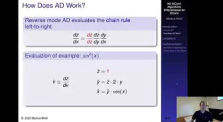
AD-OCaml is a library framework for calculating mathematically exact derivatives and deep power series approximations of almost arbitrary OCaml programs via algorithmic differentiation. Unlike similar frameworks, this includes programs with side e...
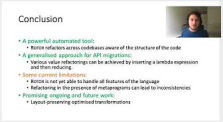
In this talk we describe our experience in using an automatic API-migration strategy dedicated at changing the signatures of OCaml functions, using the Rotor refactoring tool for OCaml. We perform a case study on open source Jane Street libraries ...
Irmin is an OCaml library for building distributed databases with the same design principles as Git. Existing Git users will find many familiar features: branching/merging, immutable causal history for all changes, and the ability to restore to an...